
 日本語




Lightweight Sound Synthesis: Unlocking New Possibilities in EVAS Sound Design
 2026.11.06
 5
As the automotive industry continues its transition toward electrification, EVAS solutions face increasing demands for real-time responsiveness, sound style flexibility, and efficient system resource management. Delivering rich, dynamically evolving sound experiences while operating within limited storage resources has become an important challenge in automotive acoustic design. To address these demands, AncSonic has developed a lightweight real-time sound synthesis solution based on parameter-driven control and a shared synthesis architecture, offering a new approach to in-vehicle sound development.
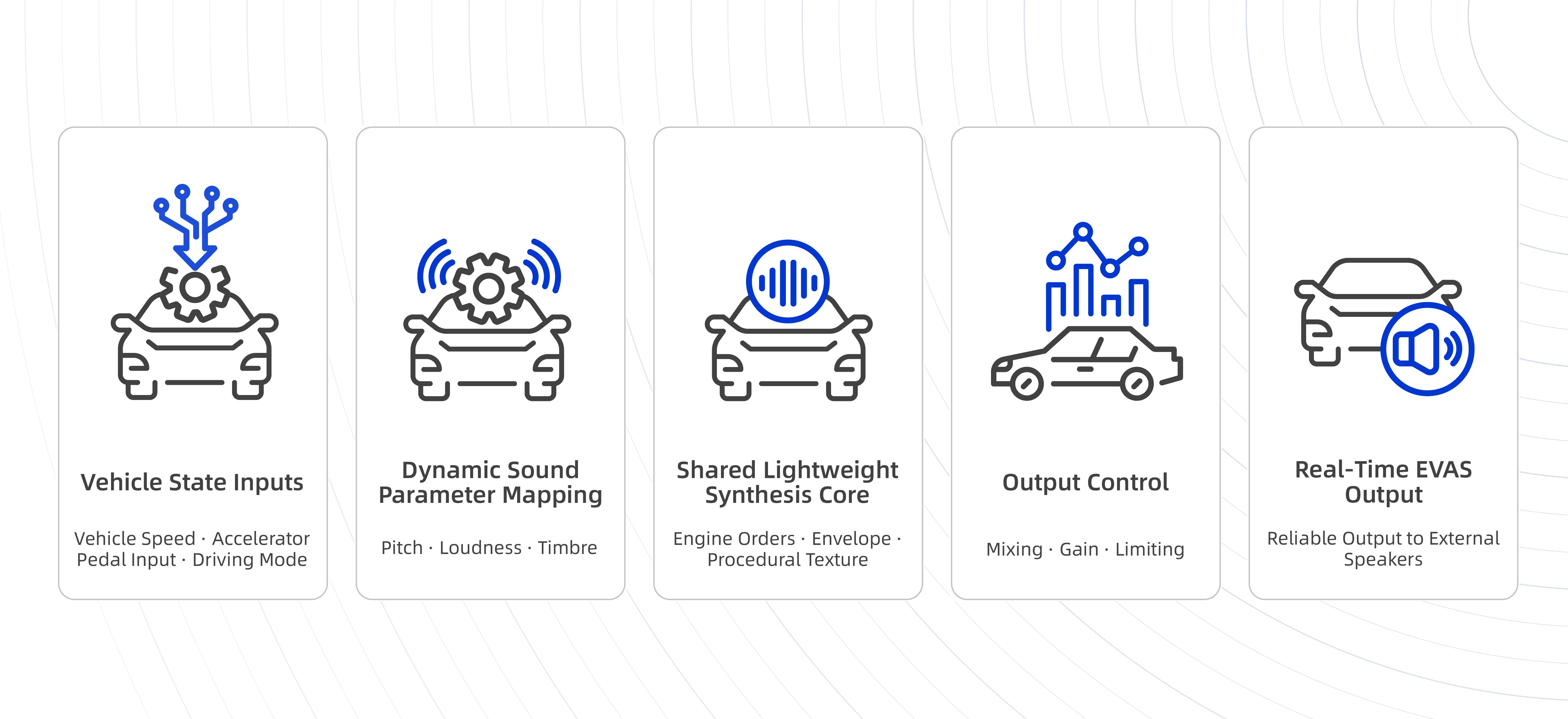
Traditional recording-based solutions typically rely on pre-recorded audio assets that must be prepared and managed in advance. Different operating conditions are then accommodated through audio asset selection, processing, or switching. When sounds need to evolve continuously in response to vehicle conditions and support multiple styles, preparing audio assets and ensuring seamless transitions can further increase development complexity. In contrast, AncSonic adopts a parameter-driven real-time synthesis approach, translating sound characteristics into adjustable parameters. Based on vehicle inputs such as vehicle speed, accelerator pedal position, and driving mode, the system dynamically adjusts pitch, loudness, and timbre, generating sound in real time through algorithms. This allows the sound output to continuously adapt to changing vehicle operating conditions.
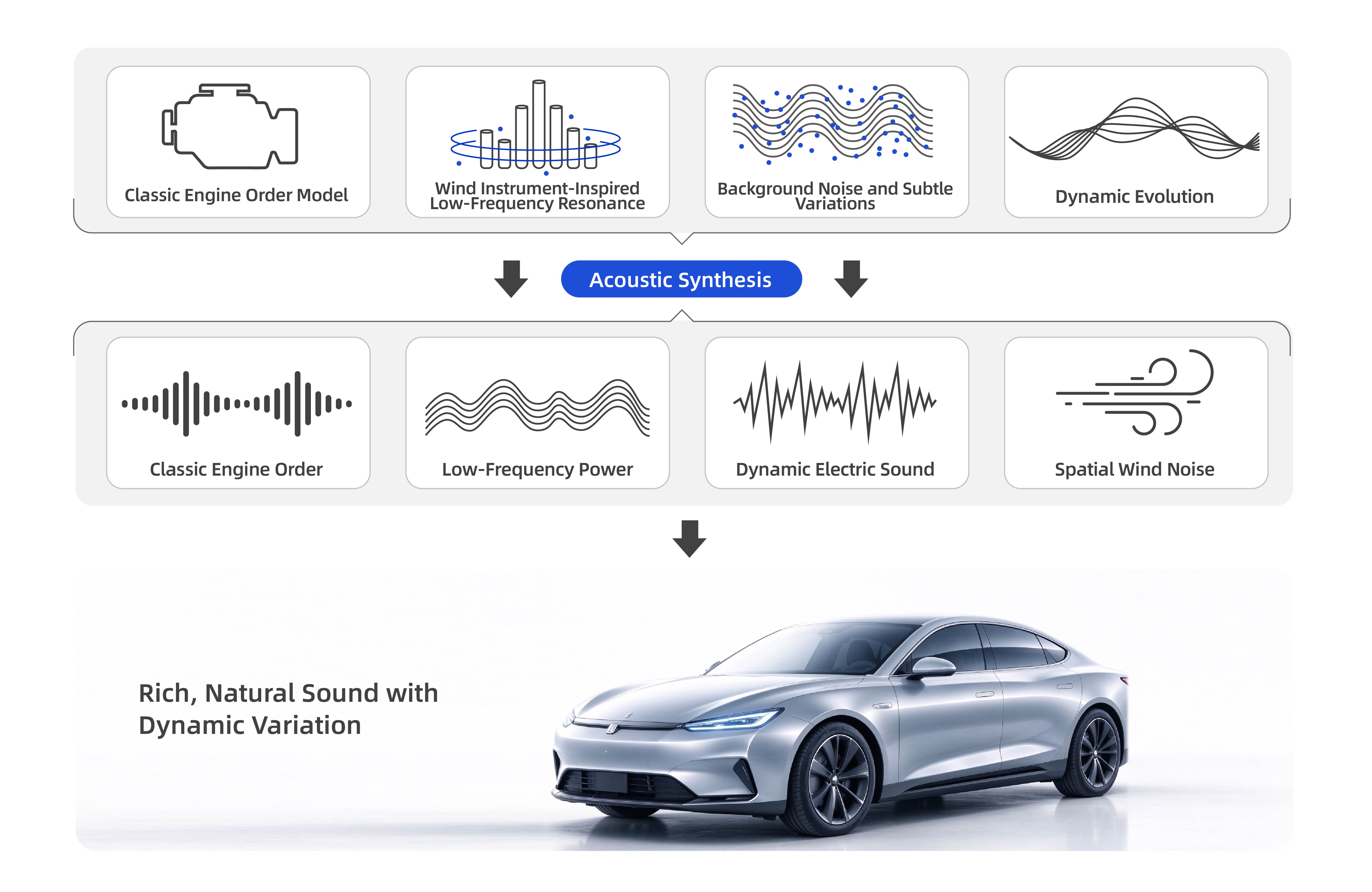
In sound design, the solution uses a classic engine-order model to establish the underlying sound structure, drawing on the richness and resonant characteristics of low-frequency wind instruments to shape the timbre. Background noise and subtle variations are incorporated to enrich the sound texture, adding depth and naturalness. Meanwhile, pitch, loudness, and timbre evolve continuously with vehicle operating conditions, maintaining overall sound continuity while delivering richer dynamic expression. Within the same synthesis framework, the solution supports four distinct sound styles: Classic Engine Orders, Low-Frequency Power, Dynamic Electric, and Spatial Wind, providing automakers with greater flexibility to develop distinctive acoustic identities for different vehicle models.
To balance real-time sound generation with multi-style flexibility, AncSonic has developed a shared synthesis core that integrates order-based structures, envelope control, and procedural sound textures into a unified sound generation pipeline. Output is further managed through mixing, gain adjustment, and limiting. Building on this architecture, the solution combines feature extraction, parameter-driven control, module reuse, and on-demand computation to establish a unified, lightweight sound generation mechanism and optimize resource utilization throughout the synthesis process. The storage footprint of the multi-style sound parameters is kept below 30 KiB. Without requiring pre-recorded reference audio assets during runtime, the system can generate different sound styles in real time, supporting lightweight deployment in automotive systems.
From sound generation mechanisms and sound style development to system architecture design, AncSonic integrates acoustic algorithms with the practical requirements of automotive applications, balancing sound characteristics, dynamic responsiveness, and resource efficiency. The solution provides automakers with a more flexible approach to sound design and development, helping them create distinctive in-vehicle acoustic experiences.
 前のニュース
関連ニュース
AncSonic Relocates and Expands Its Manufacturing Facility to Strengthen Product Delivery Capabilities
2026.10.22
The new facility offers expanded space and improved site conditions, providing stronger support for future business development and product delivery.
AncSonic × UGREEN | Hitune T9 Active Noise-Cancelling Earbuds Officially Launched
2026.10.12
Co-developed and manufactured by AncSonic and UGREEN, the Hitune T9 features acoustic optimizations across active noise cancellation, call clarity, and spatial audio.
AncSonic Showcases Advanced Acoustic Solutions at the 2026 INTERNATIONAL AUDIO-VISUAL ARTS CARNIVAL
2026.10.08
AncSonic showcased a range of products and solutions across two key application areas—intelligent headphones and automotive acoustics—demonstrating its capabilities spanning foundational R&D, product development, and large-scale production and delivery.
Making Waves in Times Square: AncSonic Brings Cutting-Edge AI Acoustic Technology to the World
2026.09.09
Appearing in Times Square marks an important milestone in AncSonic’s journey onto the global stage.